South Wales Metro electrification aims to cut Cardiff gig queues


 BBC
BBCWith 99% of the South Wales Metro network now electrified, it is hoped big queues following major events in Cardiff will become a thing of the past.
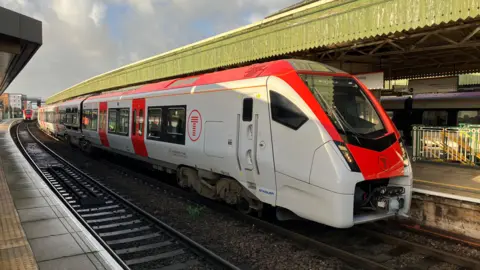
Tri-mode trains – that can switch between electric, battery and diesel – have now been introduced on the Rhymney Valley Line, with the Cardiff Bay section set to be the last to be electrified in early 2026.
Transport for Wales (TfW) said the new trains will increase capacity and reduce waiting times at Cardiff Central, when tens of thousands queue after rugby internationals, or major concerts by acts such as Oasis and Taylor Swift.
Commuters hope years of disruption from electrification works are now coming to an end – with one woman describing how she gave up her job as it was taking her 2.5 hours to get from Merthyr Tydfil to Cardiff.
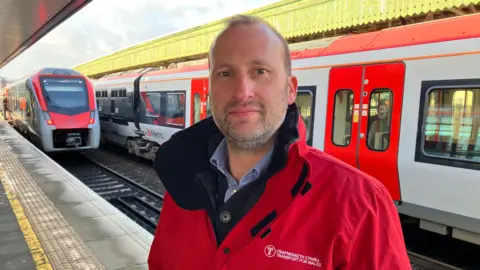
“The new trains are significantly increasing capacity over what we’ve had previously, and that means that we can move more people more frequently,” said TfW’s chief infrastructure officer Dan Tipper.
“So if we have events in Cardiff, for example, we’ve got a much better throughput of people.
“So we can move that bulk of passengers away from the centre faster. That should improve the queuing at Cardiff Central as well.”
The £1bn project brought electric train services to the south Wales valleys for the first time last year and fully electric tram-trains will provide more frequent services and increased capacity.
TfW said in 2026, 12 trains an hour should pass through Pontypridd on the Merthyr Tydfil, Aberdare and Treherbert lines.
Passenger numbers on valleys lines are still down on pre-Covid years.
While people working from home has played a part, Karen Jones, from Merthyr Tydfil, gave up her job in Cardiff because of disruption caused by the electrification work.
“Getting 25 miles down the road would sometimes take two and a half hours,” she said.
“I couldn’t get to work on time so I gave up my job. They’re a lot better but they should be a lot faster with all this money that they’re spending. It has improved but it’s not where it should be.”
Rhys Lewis, from Rhymney, Caerphilly county, described it as “a nightmare” when early morning trains are cancelled and he is late getting to work in Cardiff for a 9:30 meeting.
“My biggest complaint is the late night trains which finish at around 10.30pm, which means we have to get Ubers or taxis home which is incredibly expensive,” he added.
But Alex Bailey, from the Rhondda Valley, believes there has already been big improvements on the line he uses.
“The new trains are a big improvement on the old ones. (The investment) is a lot of money but it does seem a lot better,” he said.
“They do seem to be a lot more frequent, a lot more reliable. It’s a big investment but I think it’s worth it.”

Transport journalist Rhodri Clark says Wales is on the right track, but is disappointed that tri-mode trains to carry diesel are needed.
“There are still a lot of cities and city regions in the UK which don’t have many electric trains, or none at all,” he said.
“Bristol, for example, which is a lot bigger than Cardiff, doesn’t have any electric trains.
“These things are a bit of a double-edged sword, because while it’s great to see this technology, the diesel equipment, the extra weight of diesel that we’re carrying around on these trains would be totally unnecessary if we had a more rational approach to electrification in the UK and all of those lines were electrified at the same time.”
 Getty Images
Spending on rail infrastructure is a political hot potato in Wales with Plaid Cymru in particular arguing that Wales is being short changed by as much as £4bn because HS2 was designated an England and Wales project.
In June the Chancellor Rachel Reeves announced that the Treasury would be providing £300m for five new stations around Cardiff and Newport between 2026 and 2030, and a series of improvement works including measures to improve capacity in north Wales.
Another £48m would be spent on the South Wales Metro.
The Welsh government said it is pushing for further electrification of lines around Wales.
But it doesn’t believe devolving sections of lines such as the Great Western – which runs from stations such as Swansea and Cardiff, into England and to Paddington in London – is the solution.
“I’m not sure we’re wanting the devolution of it,” said minister for delivery Julie James.
“Really what we want is the funding formulas to be right and the organisation of it to be right so that we have a loud voice for Wales in what is done in Wales and actually we have a very good working relationship with the UK government about which railway stations will be invested in.
“I’m not a separatist politician at all. I want to work inside the UK infrastructure. It’s very important to me that the Great Western Railway line goes all the way to London seamlessly, you know, I don’t want it to only work to the border.
“If you did devolve the whole of rail infrastructure to Wales, you’d want to be really certain that all the money that you needed for that came with, I’d be very concerned whether that would happen as a one off event.”
Once the tri-mode trains are in operation on the Rhymney Valley line, new trains will be introduced on the Ebbw Vale, Cheltenham and Maesteg routes.


إرسال التعليق